

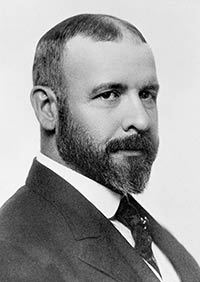
Louis Henry Sullivan was a prodigious American architect called as “father of skyscrapers” and “father of modernism”. Form follows function
- Sullivan’s famous axiom
As an architect, critic and mentor Louis H Sullivan had an impact on architecture that extends well beyond his works in Chicago. Sullivan’s influence set in motion some of the most important ideas in modern architecture.
Sullivan led a sheltered childhood as a result of civil war, and spent a good deal of time on his grandparent’s farm outside the city. It is here that Sullivan developed on intense concept of nature which would be apparent in his later works. By the age of twelve, Louis decided to pursue a career in architecture. His first employment came as a craftsman for the firm Furness and Hewitt in Philadelphia. An economic panic resulted in his layoff from the firm and his relocation to Chicago. It was here that he went to work for Major William LeBaron Senney. It was not long before Sullivan had acquainted himself with numerous architects.
He travelled overseas and studied in Europe and returned to Chicago in 1875. Dankmar Adler and Sullivan formed a partnership which lasted for years. Sullivan designed and Adler took care of the engineering. Sullivan had two main protegers over the course of his career. Frank Lloyd Wright was his chief drafts man later Elmslie took over and had an influential hand in Sullivan’s word.
In relatively short amount of time, Sullivan achieved many strides in American architecture. His works were based on the Romantic Movement of the time and his most common building ornaments depicted flowers. He constructed diverse types of structures including residences, offices, banks, warehouses, factories, theaters, auditorium. Sullivan was always one to incorporate the latest technological advances into his work. He was the first to utilize steel frame work in his construction in 1884. It was the structure that paved way for modern day skyscrapers. He was the one to first utilize electric elevators and incorporate it seamlessly into his masonry.
Chicago school was a group of architects and engineers who, in the late 19th century developed skyscrapers. They include Daniel Burnham, William Le Baron Jenney, John Root, and the firm of Dankmar Adler and Louis Sullivan who was the main architect. Some of the distinguishing features of the Chicago School are the use of steel-frame buildings with masonry cladding (usually terra cotta), allowing large plate-glass window areas and limiting the amount of exterior ornamentation. Sometimes elements of neoclassical architecture are used in Chicago School skyscrapers.
Sullivanesque Style has come to be known as the tripartite design for tall buildings – three definitive exterior pattern for the three functions of a multiple use skyscraper. First there was a base level with a ground floor for business that required easy access, these floors were followed by an infinite number of stories for offices designed to look the same. The last was the attic storey and a distinct cornice. For Sullivan, the characteristic feature of a skyscraper was that it is tall and so the building’s design should serve that goal by emphasizing it’s upward momentum as the saying goes Form follows Function.
Sullivan did not just design great buildings, he influenced history. He was one of the first architects to build skyscrapers. When people look at major cities now that is all they see from a distance. Sullivan created what is known as ‘functional architecture’. In functional architecture the form of the building outside reflects what the building is used for inside. Which is what the axiom Form follows function is all about.
Some of the famous structures done by Sullivan are The Wainwright Building, Sullivan Centre, Carson, Pirie, Scott and Company Building, Bayard–Condict Building, Auditorium building, Guaranty building. These were the skyscrapers. One of these skyscrapers fascinated me the most through its design, the Carson, Pirie, Scott building which stands on the corner of East Madison Street in Chicago. This building was Sullivan’s great project and culmination of his entire career.
Thank you.
Priyanka