

On the brighter and glamorous side of Mumbai lies tall skyscrapers representing luxurious living. On the contrary, lies the stark blue corrugated roof settlements - urban slums.
Mumbai, formerly known as Bombay, is the capital of Maharashtra and the commercial capital of India. It is an ever growing city and the “city that never sleeps”. It attracts thousands of visitors today. It is known for its showbiz and high-life living. This also means that it is India’s most populated city. Mumbai has the largest number of skyscrapers and slums in south Asia. This is a reflection of a dire issue of division of rich and poor in the city.
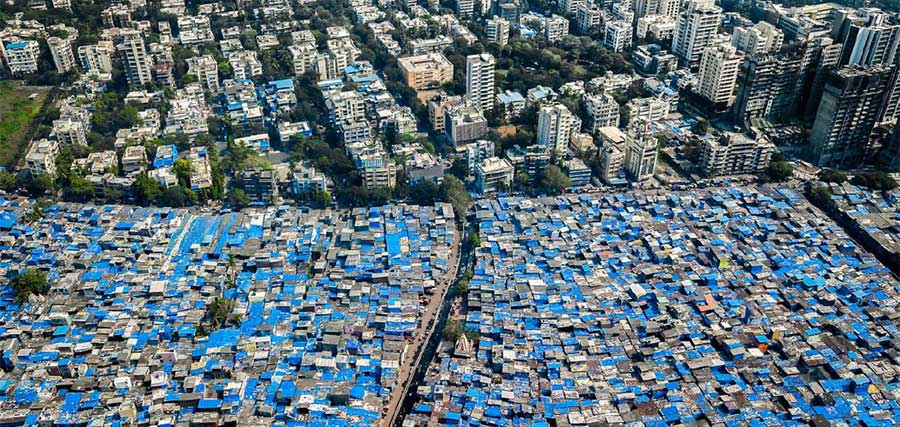
Skyscrapers are a result of private land owners maximizing profit from a limited land area. It also has a high-end market and demand of the rich. It provides luxurious lifestyle to its inhabitants but create a hard living condition for those who can’t afford it.
“ Everywhere on the ground lay sleeping natives-- hundreds and hundreds. They lay stretched at full length and tightly wrapped in blankets, heads and all. Their attitude and rigidity counterfeited death.”
- Mark Twain on his drive through Bombay in 1896
If one looks at the map of Mumbai now, he would notice clusters of informal settlements - slums, across the city. 52.5% of Mumbai’s population lives in them, crammed into just 9% of the city’s geographical area. Slums aren’t just small housing for the poor - narrow streets, unhygienic living conditions, poor sanitation make it a living hole for humans!
Dharavi is one such slum - the largest in Asia. As one lands in Mumbai, he definitely notices the cramped scrawl of corrugated iron roof huts. But Dharavi wasn’t always this way. It was an island with a predominantly mangrove swamp. It was a sparsely populated village before the late 19th century, inhabited by Koli fishermen.
So what led to this massive change? Why is the contrast so high between in living styles of people? It all began with industrialization. There was high demand of labour and Mumbai was full of human resource. But capitalists ignored the necessity of safe housing for the workers. This continued and led to urbanization, making the rich richer and poor poorer. It’s saddening that the situation now isn’t any better. Housing now is largely privately owned - a business in Mumbai, and in such a crowded state housing is scarce for anyone who isn’t wealthy. There aren’t enough affordable housing options for the poor forcing them to settle in the slums.
The poor are suffering but they have built their life in slums now. It almost works like a city within a city. They have a sense of community. So much so that in initial survey for Dharavi redevelopment, people refused to live in separate apartments, they did not want to live away from the neighbourhood that they were forced to create for themselves. Their daily bread, lifestyle, living - everything revolves around the slums. The thought of being left in apartment blocks without money or stable job, unable to pay for rent, electricity scares them. Slums have to be looked upon through different layers to be able to make a change.
Mumbai is infamous for its contrast - tall skyscrapers against low metal sheet temporary houses, the beautiful Marine Drive built on an island and the narrow streets filled with garbage in slums. Despite these, Mumbai remains to be the dreamer’s city. It has a bustling flair with an entrepreneurial spirit.