

Teachers Training Program (TTP)
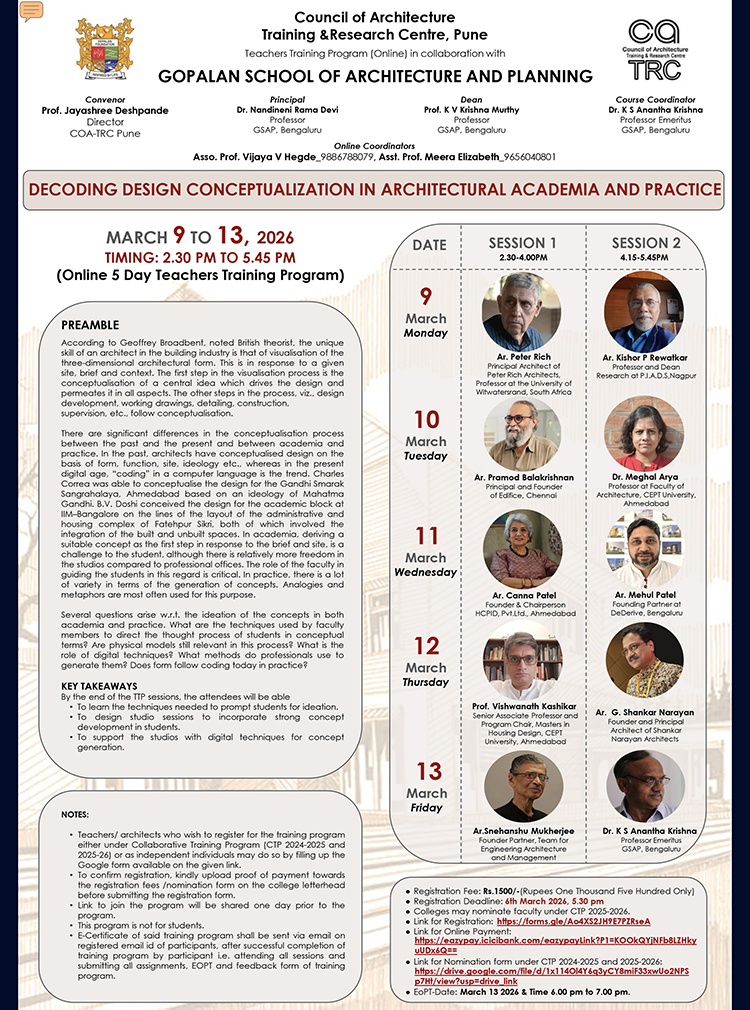
The Council of Architecture – Training & Research Centre, Pune, in collaboration with Gopalan School of Architecture and Planning, organized a 5-Day Online Teachers Training Program titled:
“Decoding Design Conceptualization in Architectural Academia and Practice.”
Dates: 9–13 March 2026
Time: 2:30 PM – 5:45 PM
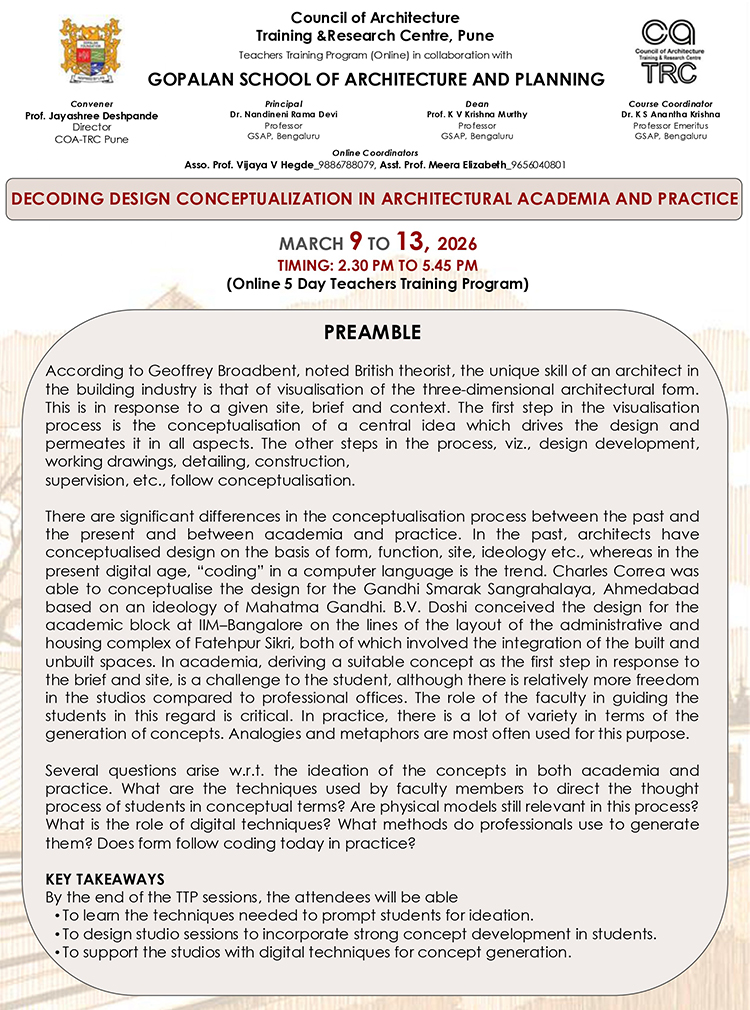
Overview/Preamble for the Program
According to Geoffrey Broadbent, noted British theorist, the unique skill of an architect in the building industry is that of visualization of the three-dimensional architectural form. This is in response to a given site, brief and context. The first step in the visualization process is the conceptualization of a central idea which drives the design and permeates it in all aspects. The other steps in the process, viz., design development, working drawings, detailing, construction, supervision, etc., follow conceptualization.
There are significant differences in the conceptualization process between the past and the present and between academia and practice. In the past, architects have conceptualized design on the basis of form, function, site, ideology etc., whereas in the present digital age, “coding” in a computer language is the trend. Charles Correa was able to conceptualize the design for the Gandhi Smarak Sangrahalaya, Ahmedabad based on an ideology of Mahatma Gandhi. B.V. Doshi conceived the design for the academic block at IIM–Bangalore on the lines of the layout of the administrative and housing complex of Fatehpur Sikri, both of which integrated built and unbuilt spaces. In academia, deriving a suitable concept as the first step in response to the brief and site, is a challenge to the student, although there is relatively more freedom in the studios compared to professional offices. The role of the faculty in guiding the students in this regard is critical. In practice, there is a lot of variety in terms of generation of concepts. Analogies and metaphors are most often used for this purpose.
Several questions arise w.r.t. the ideation of the concepts in both academia and practice. What are the techniques used by faculty members to direct the thought process of students in conceptual terms? Are physical models still relevant in this process? What is the role of digital techniques? What methods do professionals use to generate them? Does form follow coding today in practice?
The objective of this TTP is to expose faculty members to the best practices of conceptualization in design, both in academia and in practice. To achieve it, a team of experienced academicians and professionals is put together, who will share their experiences and enrich the pedagogy.
Key takeaways for participants:
By the end of the FDP sessions, the attendees will be able
- To learn the techniques needed to prompt students for ideation.
- To design studio sessions to incorporate strong concept development in students.
- To support the studios with digital techniques for concept generation.
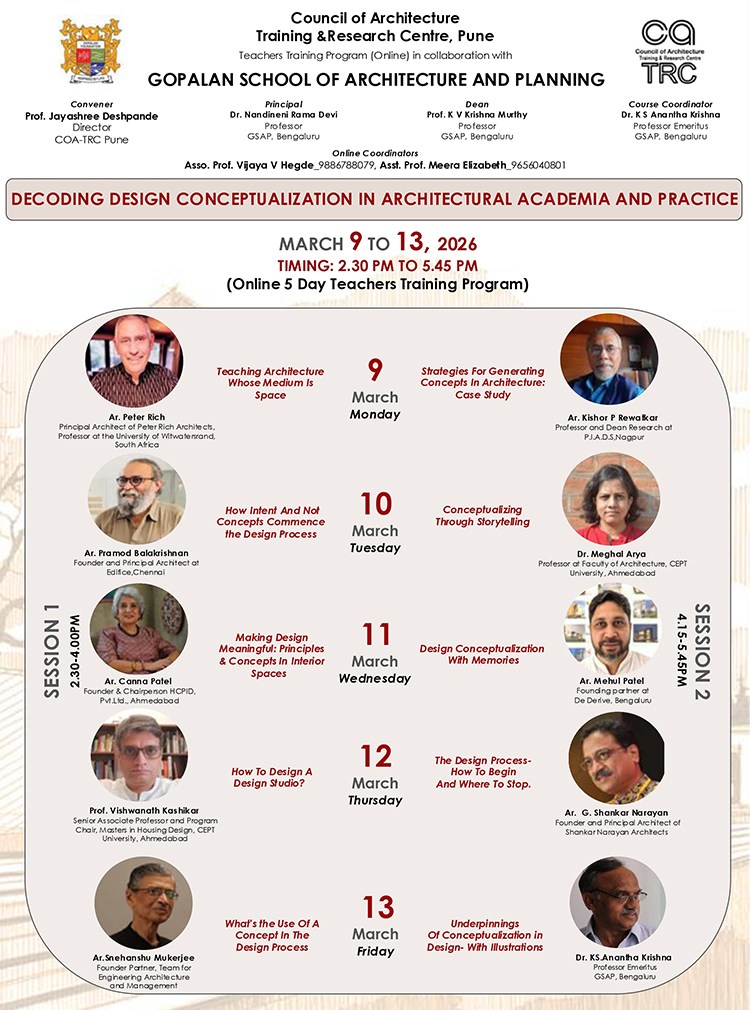
Speakers for the Event
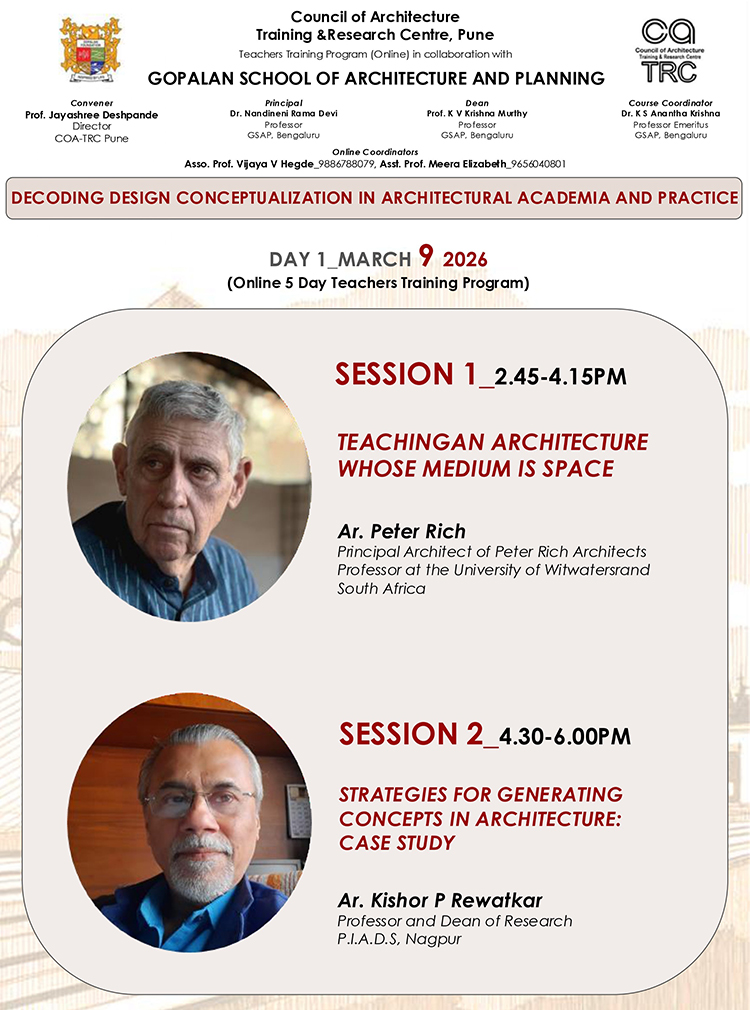
Day 1
Session 1
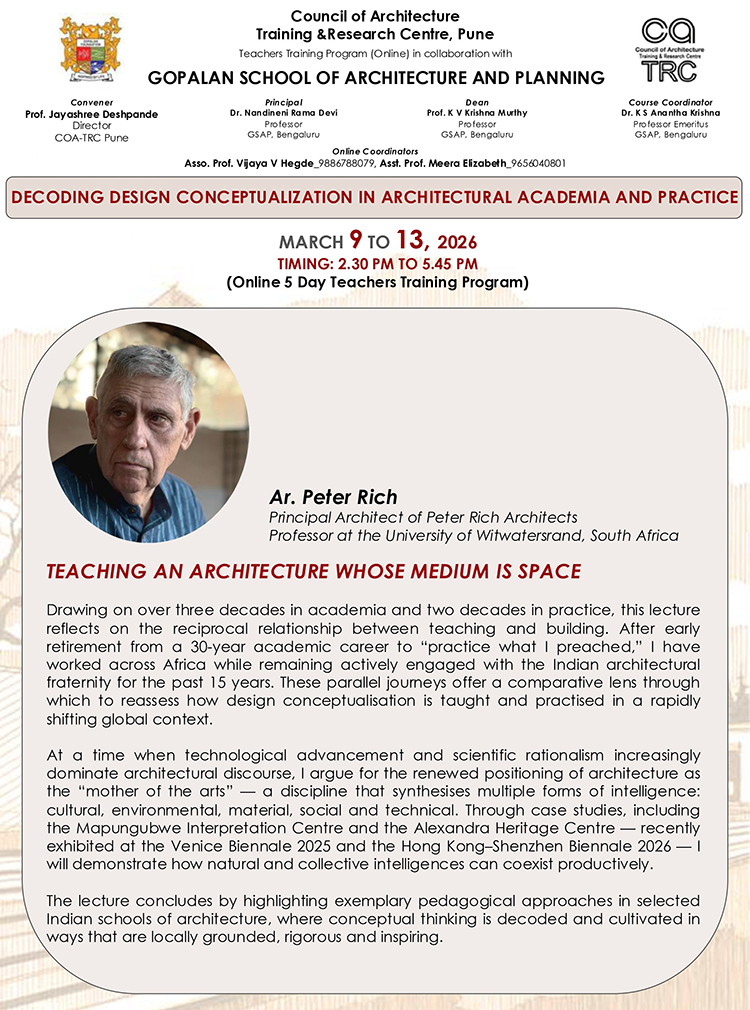
Ar. Peter Rich
Principal Architect of Peter Rich Architects
Professor at the University of Witwatersrand South Africa
TEACHING AN ARCHITECTURE WHOSE MEDIUM IS SPACE
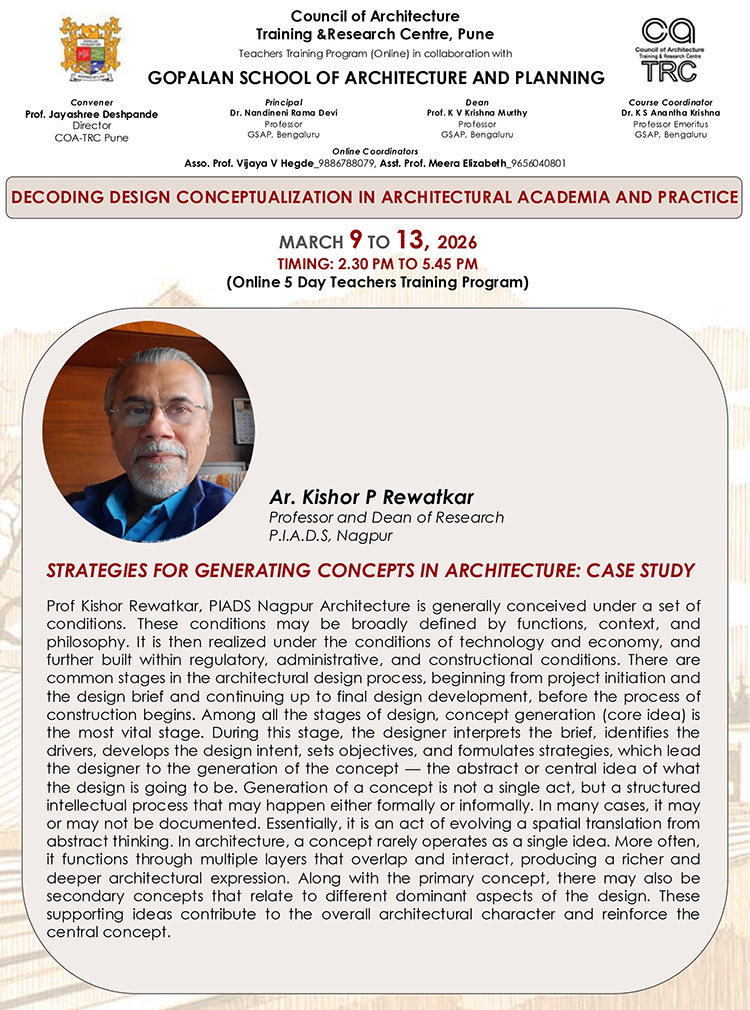
Session 2
Ar. Kishor P Rewatkar
P.I.A.D.S, Nagpur
STRATEGIES FOR GENERATING CONCEPTS IN ARCHITECTURE: CASE STUDY
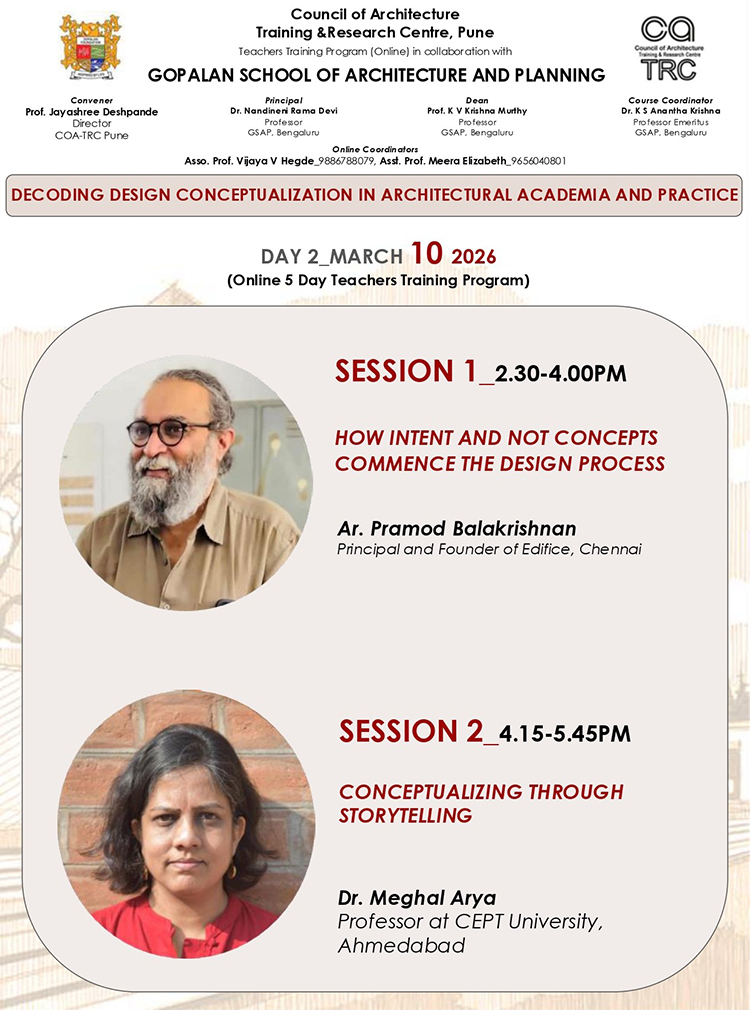
Day 2
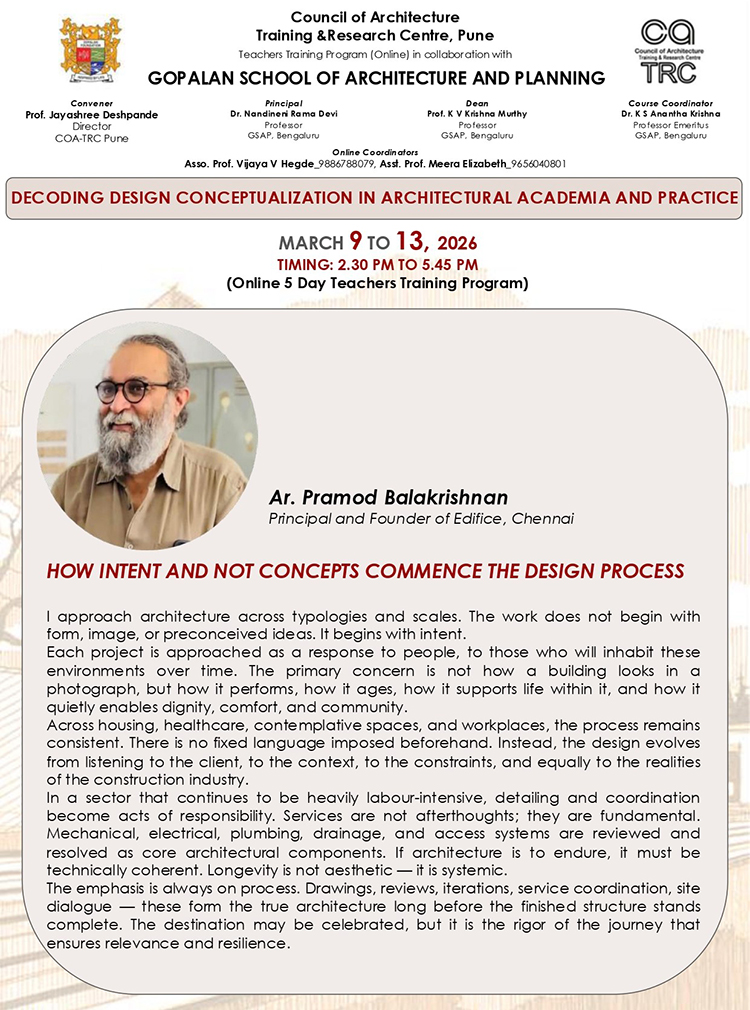
Session 1
Ar. Pramod Balakrishnan
Principal and Founder of Edifice, Chennai
HOW INTENT AND NOT CONCEPTS COMMENCE THE DESIGN PROCESS
Session 2
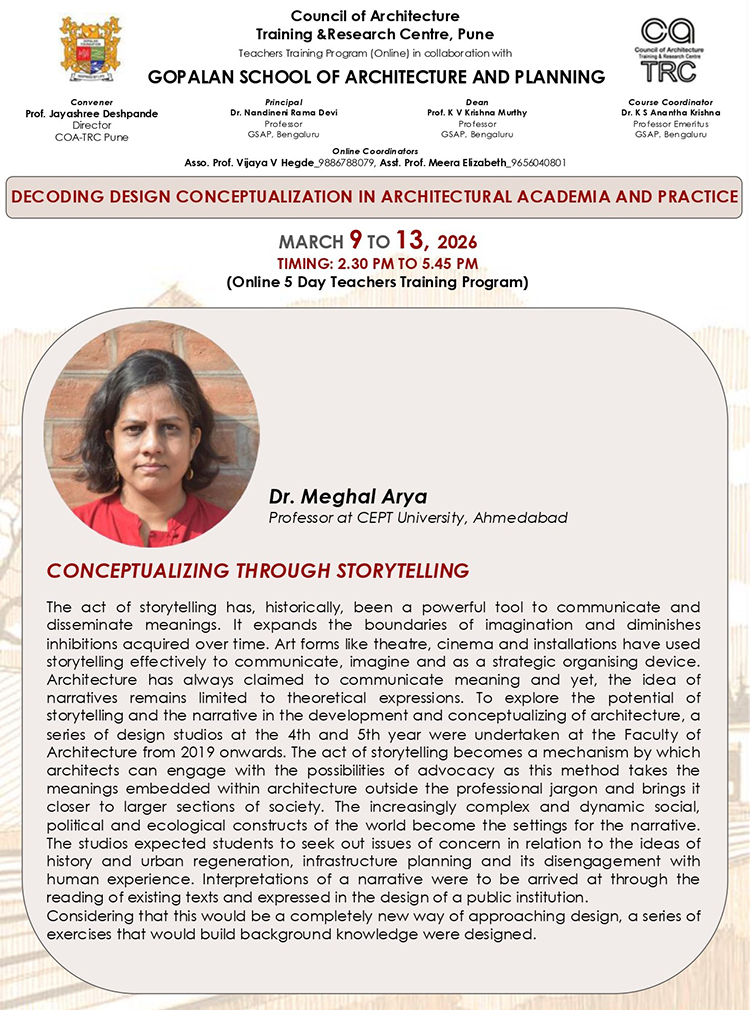
Dr. Meghal Arya
Professor at CEPT University, Ahmedabad
CONCEPTUALIZING THROUGH STORYTELLING
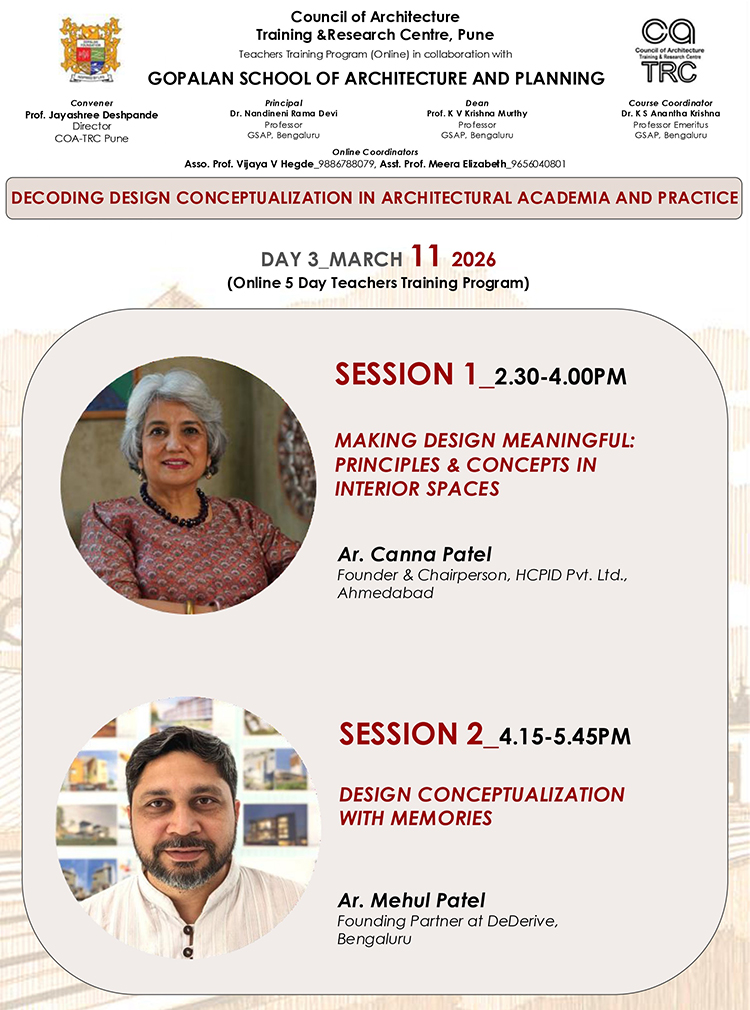
Day 3
Session 1
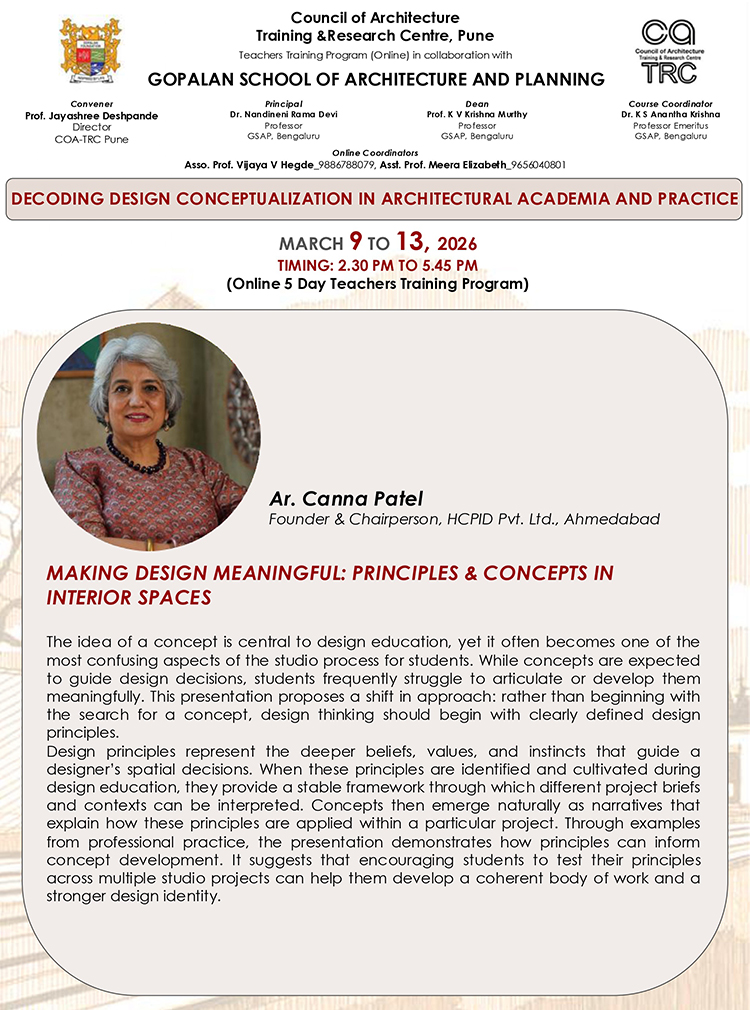
Ar. Canna Patel
Founder & Chairperson, HCPID Pvt. Ltd., Ahmedabad
MAKING DESIGN MEANINGFUL: PRINCIPLES & CONCEPTS IN INTERIOR SPACES
Session 2
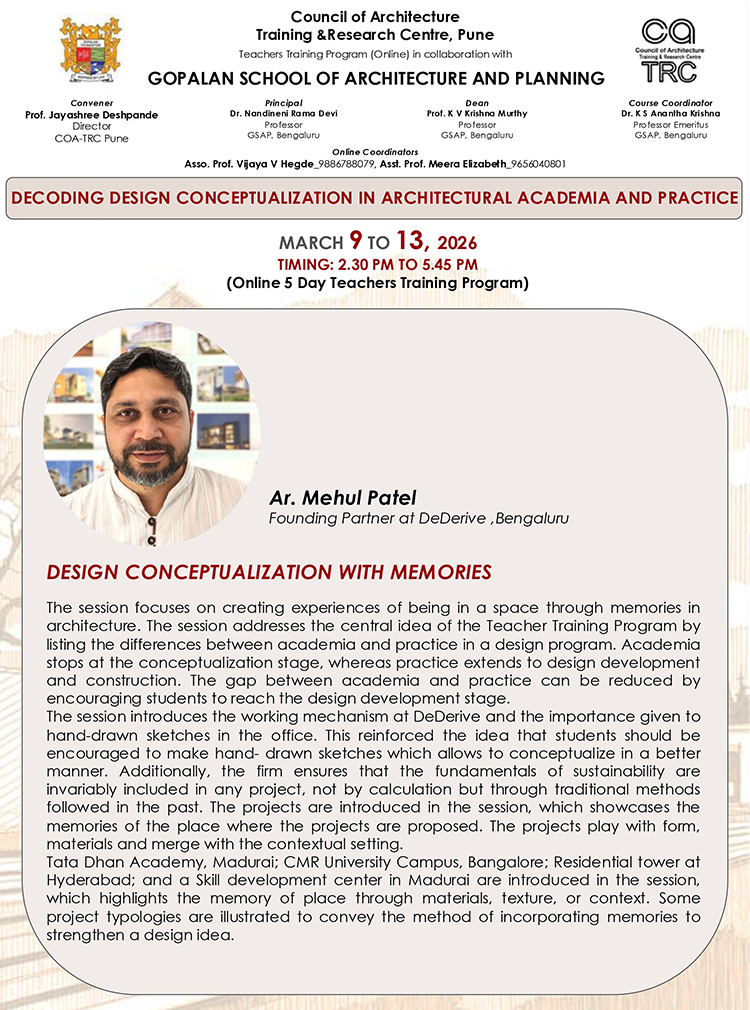
Ar. Mehul Patel
Founding Partner at DeDerive, Bengaluru
DESIGN CONCEPTUALISATION WITH MEMORIES
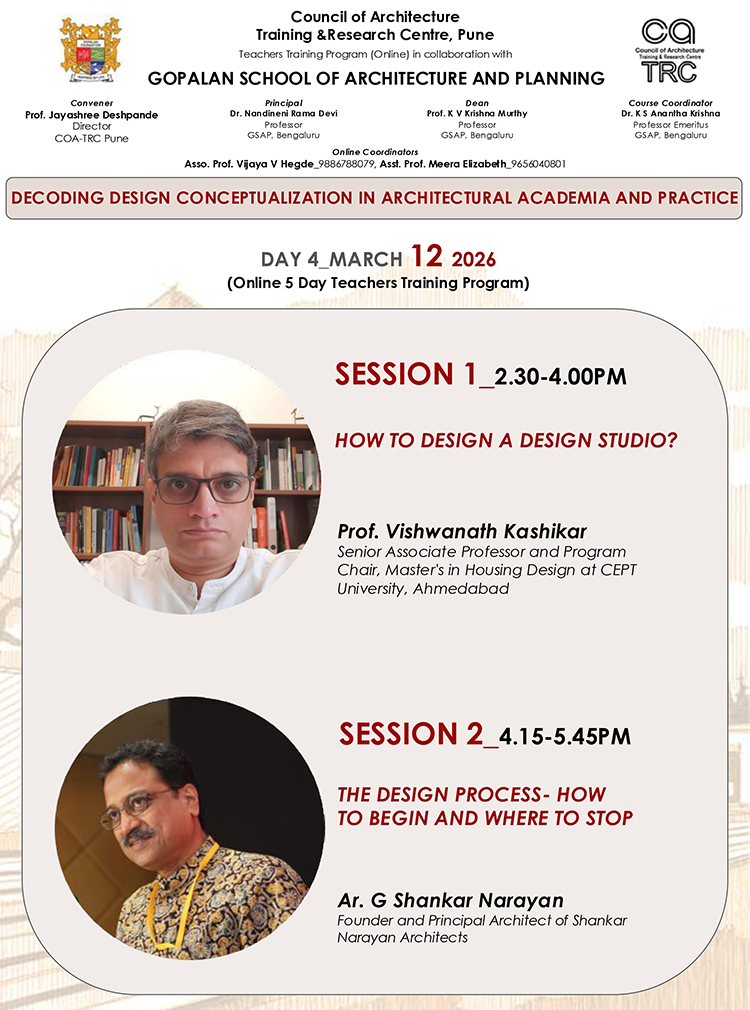
Day 4
Session 1
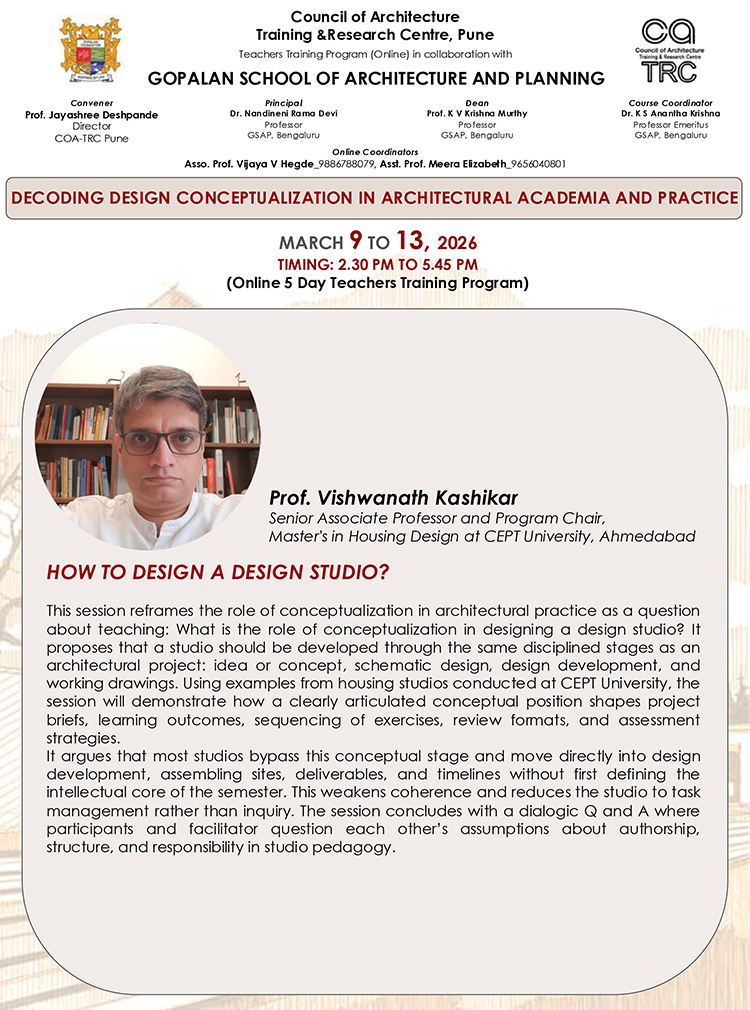
Prof. Vishwanath Kashikar
Senior Associate Professor and Program Chair, Master's in Housing Design at CEPT University, Ahmedabad
HOW TO DESIGN A DESIGN STUDIO?
Session 2
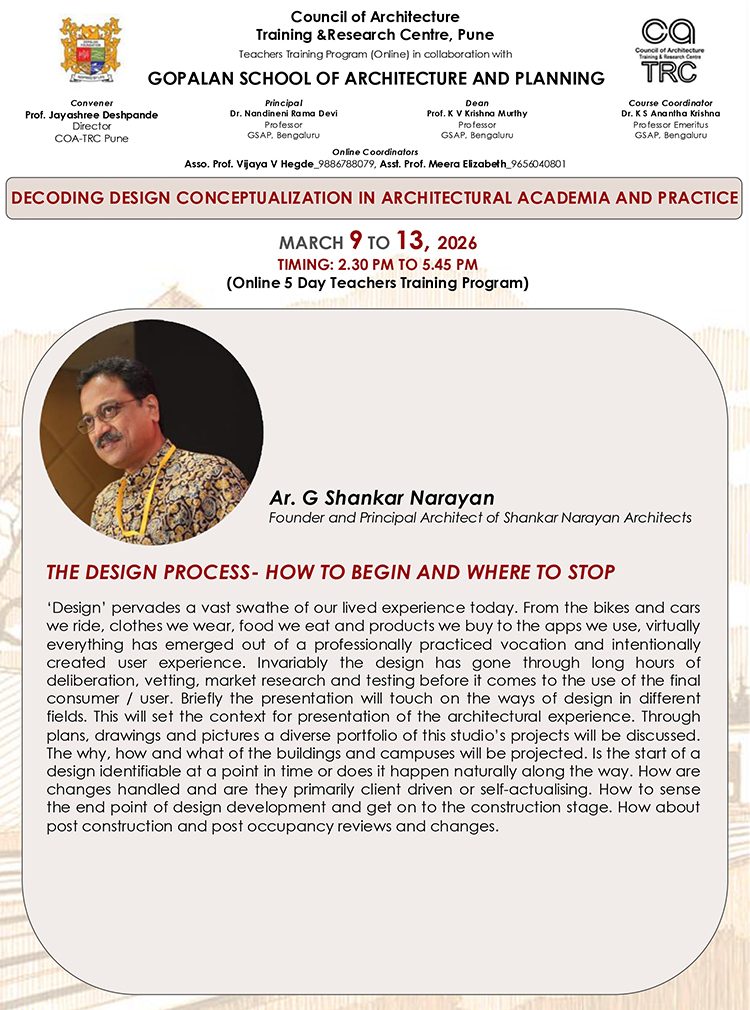
Ar. G Shankar Narayan
Founder and Principal Architect of Shankar Narayan Architects
THE DESIGN PROCESS- HOW TO BEGIN AND WHERE TO STOP
Day 5
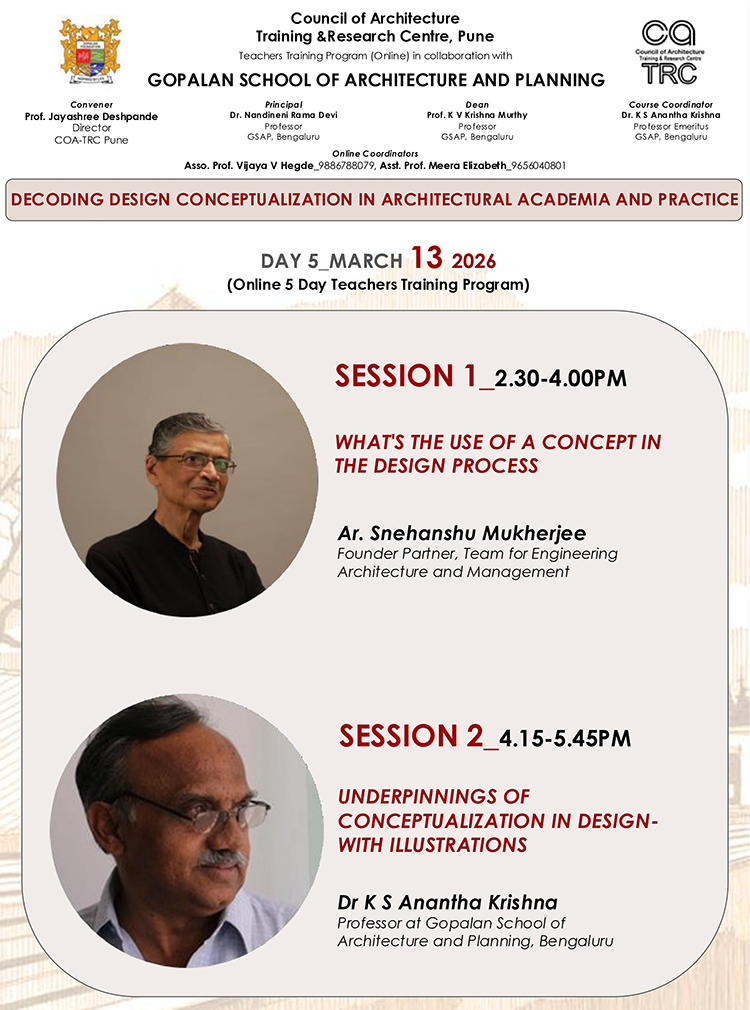
Session 1
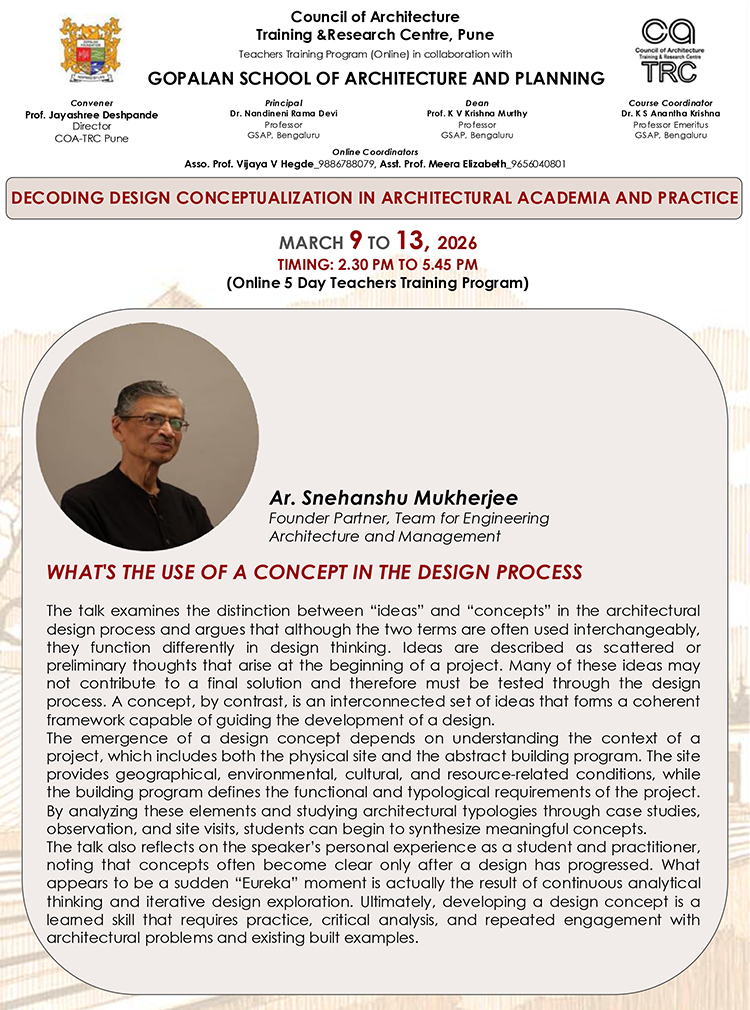
Ar. Snehanshu Mukherjee
Founder Partner, Team for Engineering Architecture and Management
WHAT'S THE USE OF A CONCEPT IN THE DESIGN PROCESS
Session 2
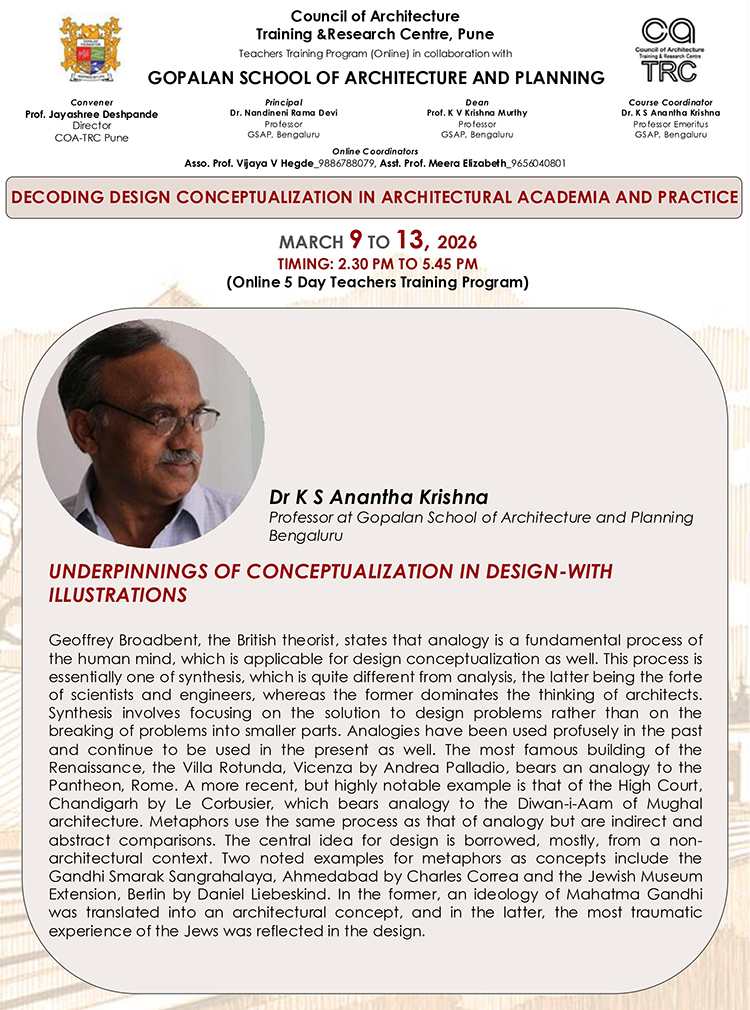
Dr. K S Anantha Krishna
Professor at Gopalan School of Architecture and Planning, Bengaluru
UNDERPINNINGS OF CONCEPTUALIZATION IN DESIGN- WITH ILLUSTRATIONS
Co-Ordinators
Program Co-ordinator:
Prof. K. S. Anantha Krishna
A distinguished academician and visionary educator, he brings with him over 44 years of rich experience in the field of architecture and education. He holds a Master’s degree from SPA, Chennai, and a PhD in Human Settlements and Environmental Studies from the IIM Bangalore. He is the recipient of the Highest Architect Teacher Award in the country, conferred by the IIA, and has also been honoured with an Honorary Doctorate from Bengaluru North University. Currently, he serves as Professor Emeritus at GSAP.
Online Co-ordinators:
Ar. Vijaya V. Hegde
An accomplished academician in the field of urban design, she holds a Master’s degree from RVCA and is currently pursuing her PhD at Christ University, Bengaluru, while serving as an Associate Professor at GSAP.
Ar. Meera Elizabeth
A dedicated academician with a specialization in Heritage Conservation, she holds a Master’s degree from the School of Planning and Architecture, Bhopal and is currently pursuing her PhD at the same institution while serving as an Assistant Professor at GSAP.
Admissions Open 2026-27